

Pop a tile onto its own monitor.
Each tile carries a TEAR pill. Press it and that Triad opens in its own window, the way the Chorix wings tear off the Theater.
AI does the work.
Your people rule on it.
AI positions propose; your people rule, and every ruling stays on the record. Ensemble is the Chorix machine run for a team. Each Triad has its own three seats and up to six stage managers with thirty-six hands; each Triad is a tile on one wall; the wall reaches every machine and VM you pin to it. Two clicks join stage managers on different tiles by a route you arm, each end its own switch; a route's far end can be another Ensemble on another machine, or another subscriber's. Every act names the person who asked for it and the person who ruled on it.
Every approved act leaves as a record. One sealed document per act, exported from the room and verified as unaltered; changing it and re-sealing it is caught. It carries a key-based proof of who issued it.
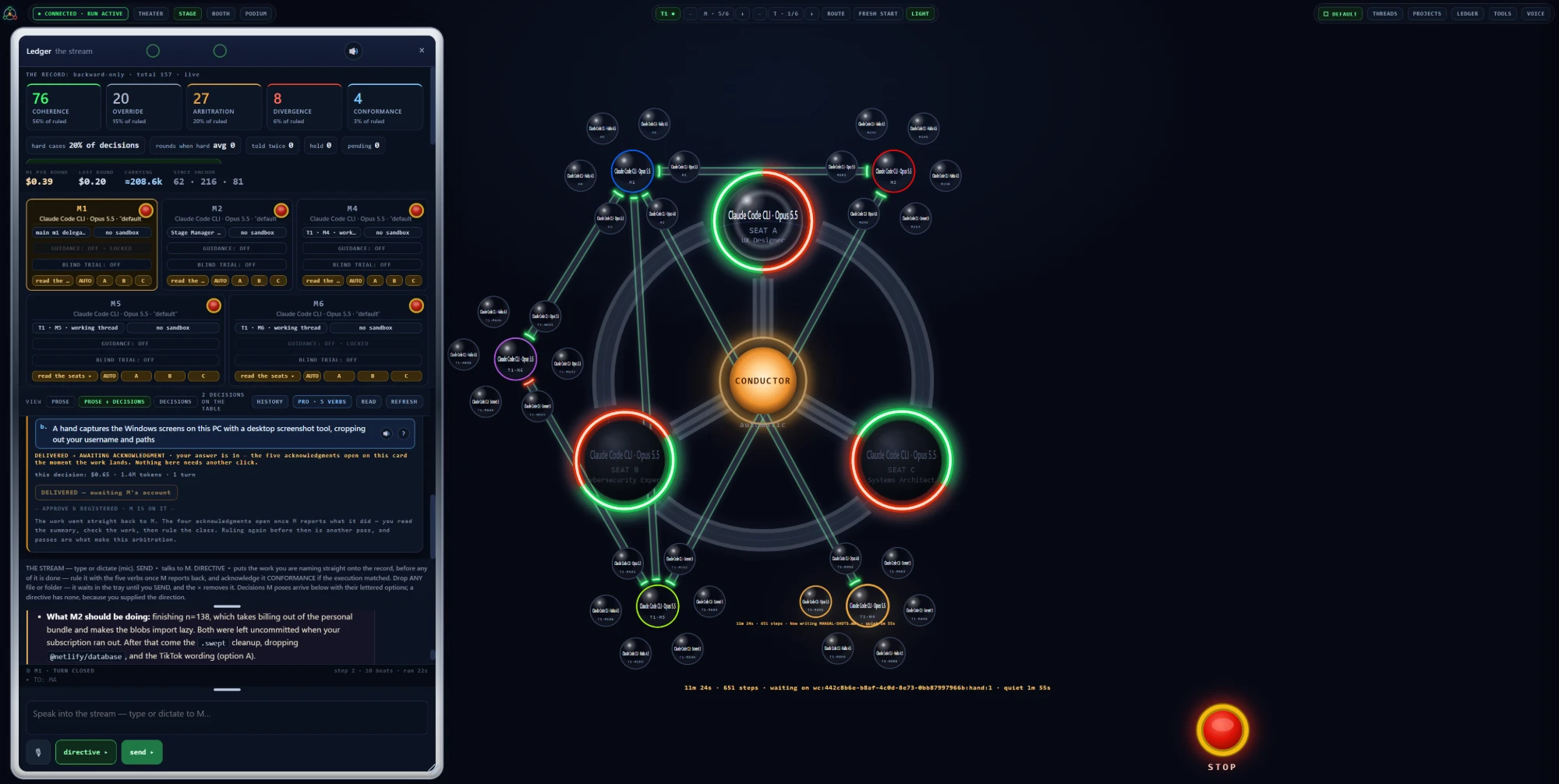
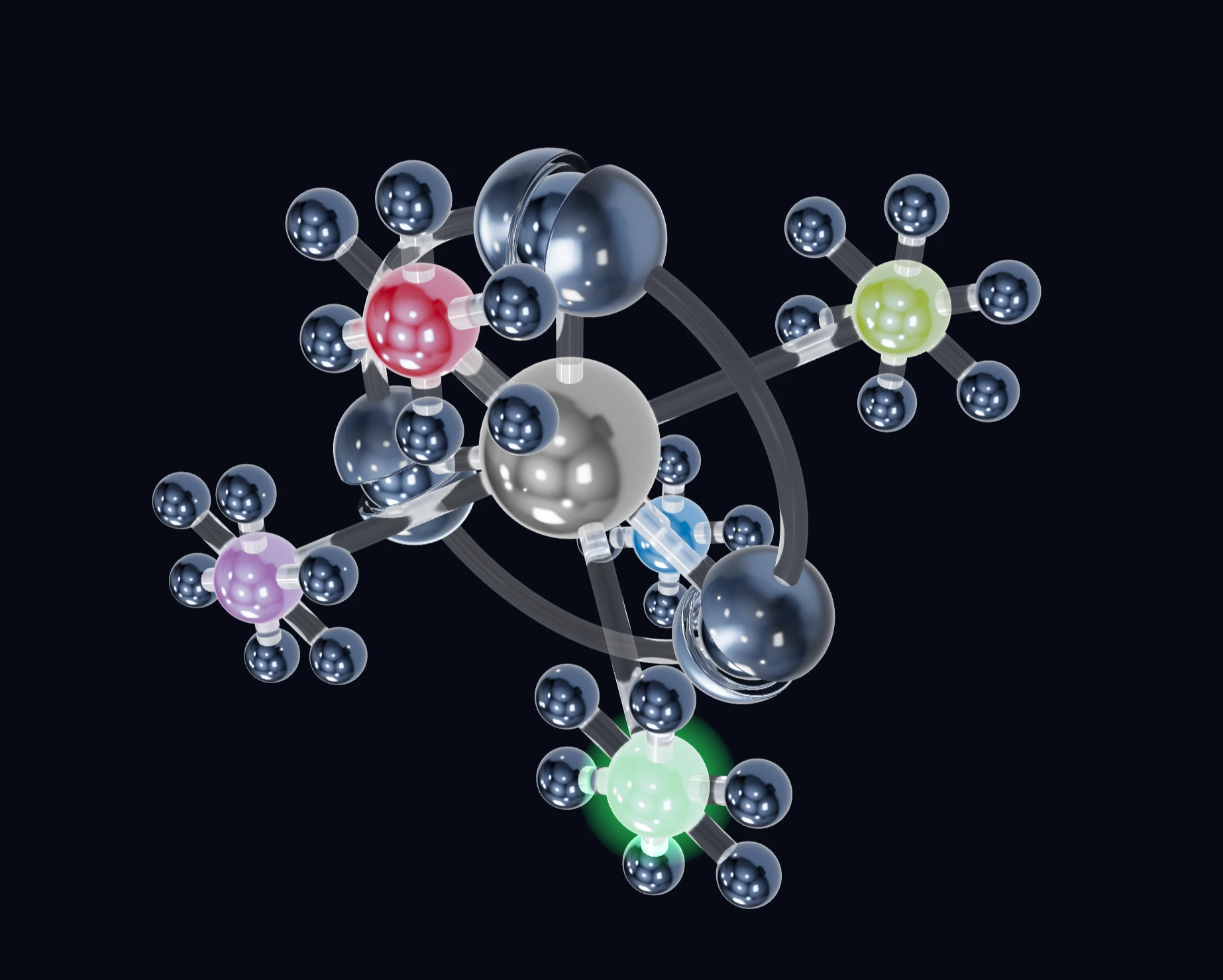
A tile is a whole Triad: its conductor core, its three seats and up to six stage-manager clusters, drawn as the real Stage scaled down. Up to six Triads sit three across on one wall, Triad 1 top-left. A click on a tile's open stage opens that Triad full screen; a click that lands on a route belongs to the route. Tiles from other machines and VMs you have pinned sit on the same wall, marked with the machine they live on.
Each tile carries a TEAR pill. Press it and that Triad opens in its own window, the way the Chorix wings tear off the Theater.
The T1 … T6 pills along the bar turn red while that Triad has an open decision on its Ledger. ALL rebuilds the wall.
Pin another Ensemble, on another PC or a VM, and its Triads appear as tiles on your wall. A route can end on any of them.
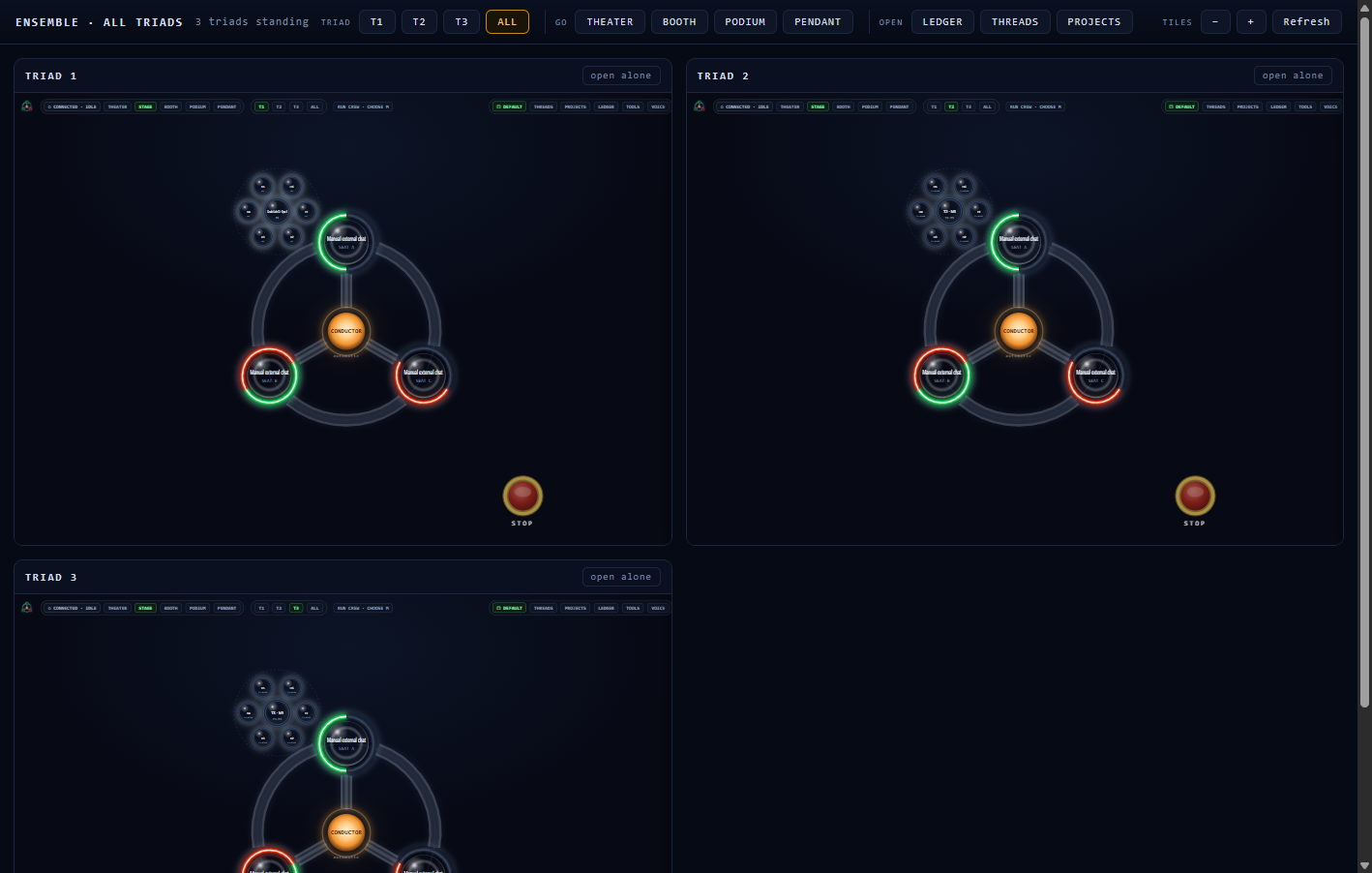
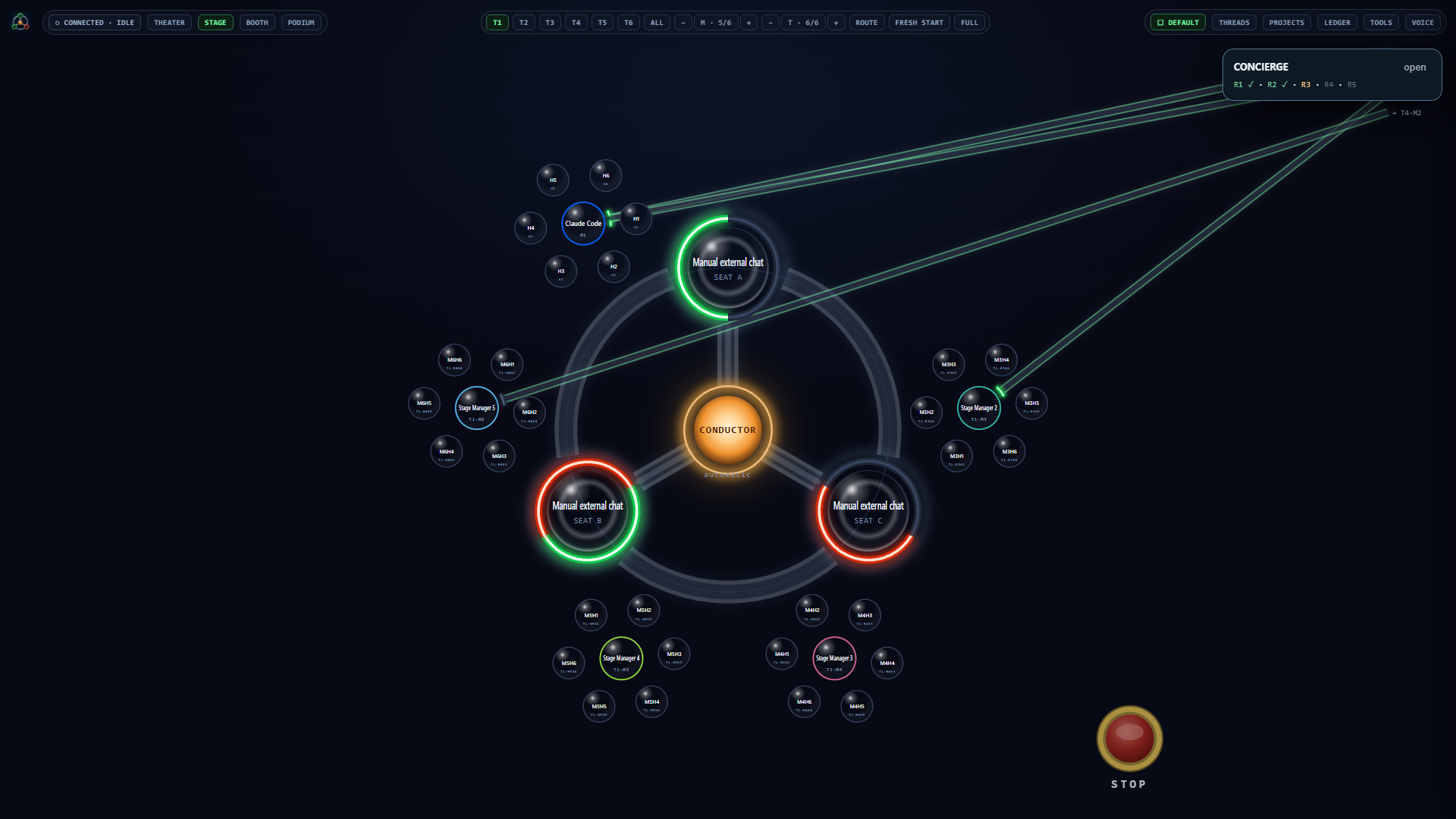
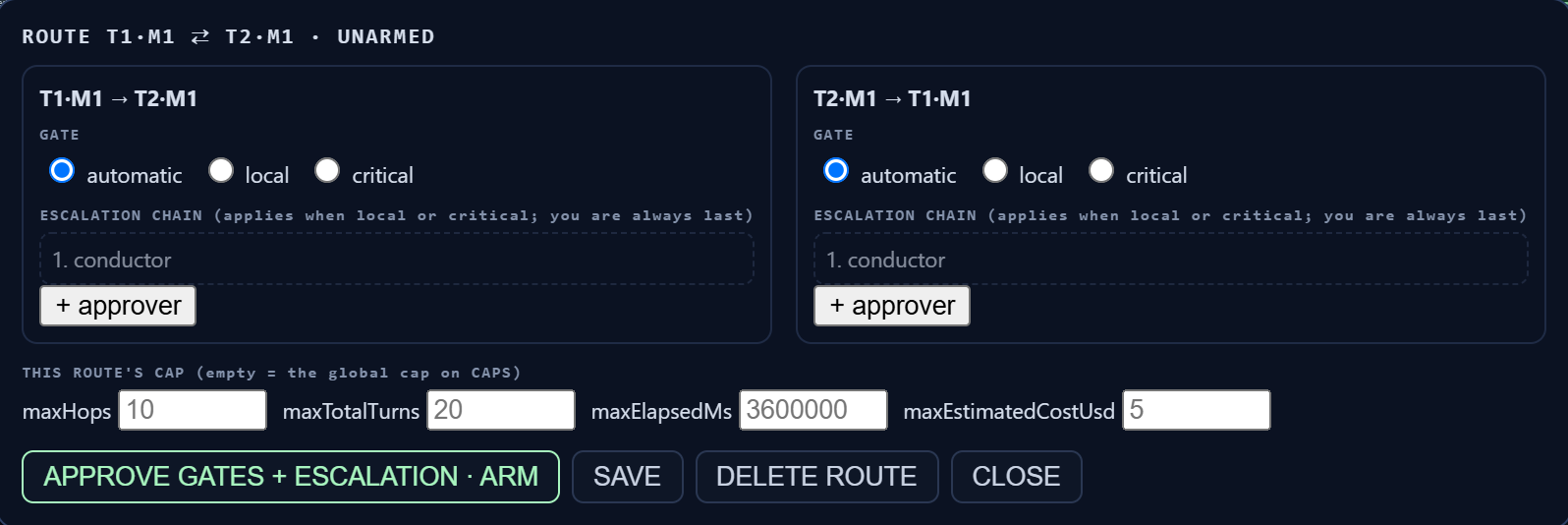
Press ROUTE, click the sending stage manager, click the receiving one: two clicks join two managers on different tiles by a two-way channel with its own gate level (automatic, local, critical) for each direction. A new route starts unarmed and never fires until you arm it from its panel. The receiving manager can live on another machine or a VM. It can belong to another subscriber, so two organisations' stage managers and hands work one chain together, each side's gate and record staying its own. It can be an outside agent, reached by the agent-to-agent protocol, and a manager of yours can stand behind an agent card for outside agents to reach.
A route ends in a short arc on each manager's ring: green sends, red receives only, dark is off. Click an arc to change that end; click the tube to set both together. Two hairlines on the tube show armed (green) or disarmed (red). A manager sends only when its own end sends and the far end is not off.
When a manager finishes, its reply text crosses to the far manager as routed work, stamped with the sender, the route, a sequence number and the time. The Ledger row and its ruling never cross. A reply that opens "TO: T3·M1", "TO: ALL" or "TO: CONDUCTOR" fires only the routes it names.
Hops, turns, elapsed time and estimated cost are capped for the whole chain of handoffs, not per run. The defaults are 10 hops, 20 turns, one hour and a cost ceiling, set globally and overridable per route. When a cap stops a chain you are told.
Each direction carries its own escalation chain: named approvers, a time limit per step, two-person steps where you want them, and you as the last step. A step that runs out of time passes the handoff on; every step taken shows on the Ledger.
A handoff leaves the machine in a signed envelope carrying the chain, its hops, its taint, a nonce and an expiry. Peers are pinned; the smaller hop cap wins; the chain is written down at the gate and survives a restart. The record stays with its principal.
Work from an outside agent arrives quoted, its route floored at a local gate, its taint carried along the chain. An outside agent can never resolve one of your approvals.
The Ensemble Stage is the Chorix Pro Stage with six manager clusters ringing the Triad instead of two: M, M2, M3, M4, M5 and M6, each with six hands. Triad 2 and every Triad after it carries its own three seats, cast on its own stage. The Stage draws in FULL, LIGHT or OUTLINE, one setting per machine.
Seat A, Seat B and Seat C are the three AI model positions of the Triad. They conjecture; a stage manager carries the work; a person rules on what comes back.
The master mushroom on the Stage halts every live run at once, with no confirmation. Each stage manager's chip on the Ledger carries its own mushroom that stops only that manager's family.
Each stage manager and hand takes skills from the app's own library through its right-click panel, up to twenty-four per position, and a manager sees each hand's skills on its roster.
Every AI position is cast at a tier: read-only, read-write, or read-write-execute. A read-only seat is fenced on the host by a hook that refuses every write; a read-write position runs under a permission hook; a read-write-execute position is the only one that can run what it writes. Each position runs in its own isolated environment, under its own account or its own VM, with nothing of the host readable to it and nothing running with permissions bypassed.
Cast each stage manager, each hand and each seat on the model you choose, from the casting library: the Claude family, the Codex family, local models and custom providers, each at its own tier. One Triad can carry a Claude stage manager beside a Codex one.
The casting library carries nineteen personas, from Systems Architect and Cybersecurity Expert to UX Designer, Financial Analyst and Product Manager. Cast a seat as one and it argues from that chair.
Eighteen general skills ship in the app's own library, from root-cause analysis to a one-page executive brief, and any position can import a skill of yours through its panel.
Point Ensemble at your organisation's own skill folder and every stage manager and hand in every Triad carries those skills, beside the library, without touching each position.
The tier control on a position arms with one click and sets with the next, so a tier is never changed by accident and never buried in a menu.
A hand below the execute tier that is refused a step hands the step back to its manager; a full-tier manager alone may spawn.
A route can end on a stage manager in another subscriber's Ensemble, so two organisations' managers and hands work one chain together. Each side keeps its own gate, its own tier fence and its own record; nothing of one tenant is visible to the other.
Everything on this page is set with a click, a right-click, a picker or a toggle on the surface itself: no configuration file, no graph editor, no form. The data-dense mechanics of six Triads, thirty-six stage managers, routes, gates, caps, tiers and castings sit behind the orbs and pills you can see. Every one of those controls is reachable from the keyboard, with a visible focus and a name a screen reader can say, so the whole room is operable without a mouse.
ROUTE, the sender, the receiver. Done. The ends are arcs you click to cycle; the tube is a click to set both.
Configure, Talk to, Clear memory, Usage metrics, Detach the wing, Add or Remove a stage hand, Remove a stage manager. Right-click a route for its panel; right-click ROUTE for the global caps; right-click the Theater for Pro Color and Pro Geometry.
T1 to T6 and ALL on the bar; −/+ for stage managers and Triads; one pill that cycles FULL, LIGHT and OUTLINE; the tier that arms with one click and sets with the next; ARM and DISARM on a route.
Every control on the Stage, the Wall, the Ledger, the Booth and the Podium is operable from the keyboard alone, to the accessibility standard the law asks of software sold to organisations.
The Chorix Pro Theater is the same 3D room; Ensemble layers stage managers M3 to M6 into it. Odd-numbered managers sit below the seat plane, even-numbered above and opposite, so six clusters of hands clear each other. The room runs in Theater, Spin, Light or Outline.
A Pro control in the Theater menu, on every Triad: the stage-manager spoke angle (default 45°), the spoke length (default 3.50) and the hand spoke (default 100%), with a clearance readout and a verdict. One geometry for the whole install; other open screens follow within seconds.
Pro Color carries a colour for each of the six stage managers, so M3 to M6 are told apart at a glance in the Theater and on the Stage.
The wall can tile the 3D Theater per Triad instead of the Stage; tiles run in the Light mode.
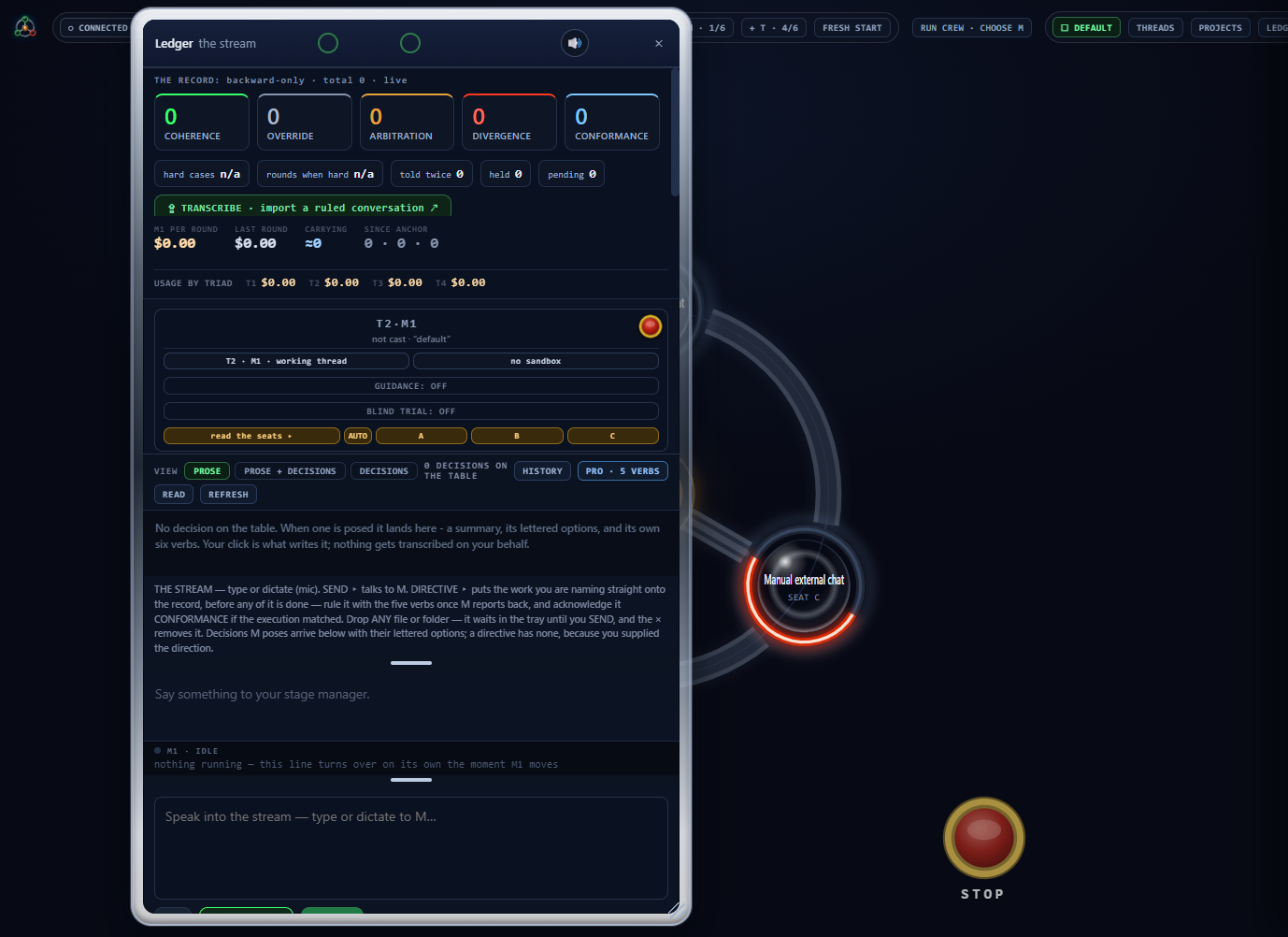
Each Triad has its own Judgment Ledger, facing only that Triad's stage managers. Each manager has a chip on it, with its own mushroom and its own delivery view, prose or decisions. A decision is posed to a person, ruled with one of five verbs, returned with proof, and closed with an acknowledgment. The ruling carries the name of the person who gave it. Every principal in the organisation has their own record, and any number of them are open at the same time, each surface saying whose record it is.
If the proposed act changes after approval, the approval is voided and has to be given again.
When an approved act runs, it is checked again, and it is refused if it changed since approval.
A grant of approval authority can carry an expiry, and past that point it no longer applies.
If an approver holds a decision past the time limit, it moves up to the next approver in the chain, and the lapse is recorded.
Every resolution is recorded with who resolved it and with the policy version in force.
When a manager puts a decision to you, your earlier rulings in that domain come with it, and managers are instructed to consult them before recommending.
After delivery, Ensemble proposes how the outcome sits against your ruling; you confirm it, and it stays on your record.
Open your own map, by domain: where you took the recommended pick and where you departed, in your own words. It ranks nothing and predicts nothing.
Ensemble runs across machines and VMs: each machine carries its own Triads, and routes join managers on any of them. Nothing bends when a handoff leaves the machine: the gate stays on the sender's side, the chain and its caps travel in a signed envelope, and the record stays with its principal. People sign in as themselves, with single sign-on (SAML, OIDC) and directory provisioning (SCIM), and hold roles: owner, admin, operator, approver, auditor, viewer. Each organisation is its own tenant; nothing of one tenant is visible to another.
An exported record names who requested the act and who approved it, by their own sign-in, not by a role word.
Each principal's record is its own corpus, served by its own process on the machine, so several principals work at the same time without one closing another.
What one machine carries is measured and published: the load curve at one, two, four and eight workcells and beyond, with memory, latency and gate time at each step, so you size machines from numbers, not guesses.
A standing drill runs every day against an isolated copy: routes cross, an unarmed route stays silent, a local gate holds, and the verdict is written down with the build it ran against.
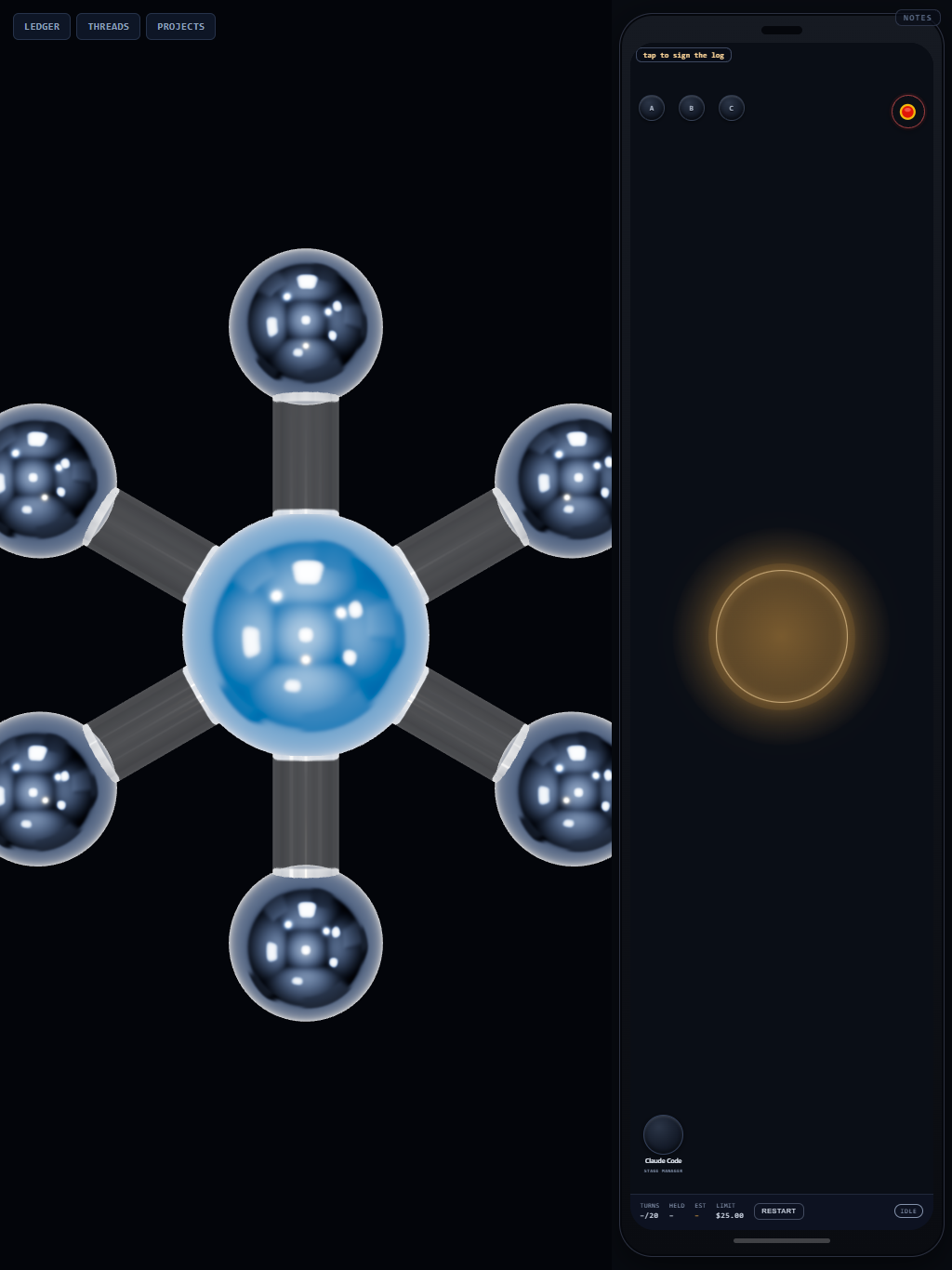
Ensemble ships the Chorix Pro Booth: the tablet view of the room, opened from the wall or the Stage, with its Ledger overlay. The Booth follows the Triad you choose, so a tablet can watch any tile on the wall, on any machine.
The wall's bar carries the three doors on the left, the Triad pills and ROUTE in the middle, and Workspace, Threads, Projects, Ledger, Tools and Voice on the right.
Choose the Triad on the Booth and it shows that Triad's stage managers and that Triad's Ledger.
Ensemble ships the Chorix Podium: the phone surface where a posed decision arrives and is ruled with one of five verbs, served on its own approval port beside the app. Every named approver has their own Podium, signed in as themselves, and a decision reaches the phone of the person whose step it is.
A decision on an escalation chain goes to the approver whose step it is; when their time runs out it moves to the next, and the lapse is on the record.
The record carries who resolved it and the policy version in force.
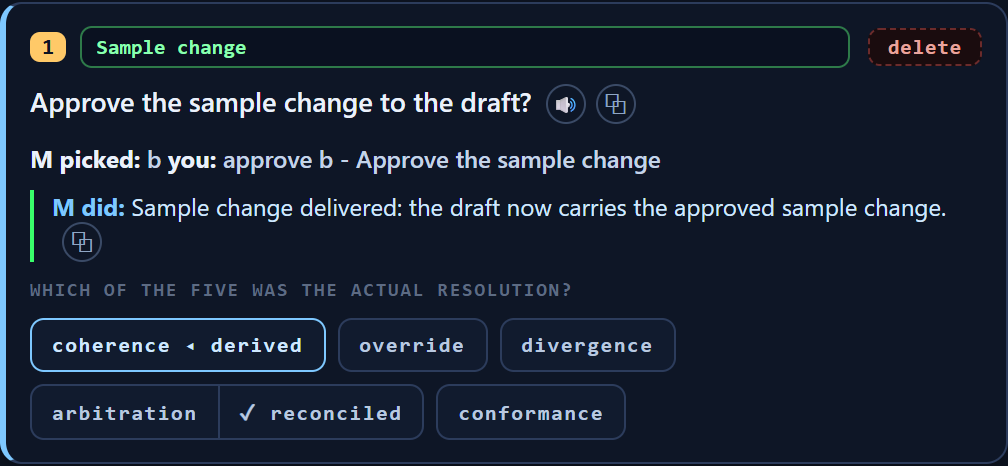
Each approved act can be exported as a record, and the record can be verified as unaltered. Changing it and re-sealing it is caught: the verifier re-digests both the whole document and the act's own fields inside it, so a record that was altered and re-sealed still fails because its evidence no longer matches the act. Each record is signed with the issuer's key, so anyone holding the organisation's public key can check who issued it.
An approved act leaves as one JSON document: the act, its evidence and digests, the resolution, the traversal, the deliveries and the events.
The verifier answers ok or not, with reasons, and says whether the evidence is intact since the act was raised for approval.
Every record opens as a readable page as well as JSON, and prints as one.
Export every record across the organisation, or for a date range, in one pass, each record still verifiable on its own.
A spending budget can be set per AI position. Ensemble runs on the machines where it is installed and keeps every record in a database on those machines. Run it as a hosted service instead and you choose where its data lives. Retention rules, legal hold, backup and restore are yours to set.
Every route carries an estimated-cost cap beside its hop, turn and time caps.
A chain that bounces between two managers, or two machines, spends against one set of caps from its first hop to its last.
The Ledger shows usage for the manager per round and a usage-by-Triad band with one figure per Triad.
Chorix Studio and Chorix Pro are bought once and owned: one payment, a perpetual licence, on one machine. Ensemble is the same machine run for a team, by monthly subscription, priced by users. Model connections are never billed: Ensemble runs on the AI subscriptions and keys your people already hold.
A band counts the people who use Ensemble. AI positions, stage managers and hands are never billable seats.
Each seat runs on a vendor sign-in or key your team already pays for. Ensemble meters nothing and never bills a token.
The Ledger, the routes and every Act Record live in your organisation's own database, on your machines or where you choose to host it.
Ensemble for a team of five people. Every Triad, every route, every machine, the Theater, the Stage, the Ledger, the Booth and the Podium.
Intentionally not offered for sale. The commerce system behind this product is built and proven.
Model connections are never billed.
Talk to usWhere a team starts.The same Ensemble for a team of up to ten people.
Intentionally not offered for sale. The commerce system behind this product is built and proven.
Model connections are never billed.
Talk to usThe same machine, more people.The same Ensemble for fifteen people or more.
Intentionally not offered for sale. The commerce system behind this product is built and proven.
Model connections are never billed.
Talk to usThe organisation band.Intentionally not offered for sale. The commerce system behind this product is built and proven.
Billed monthly in US dollars. Cancelling stops the next renewal. Ensemble does not bundle or resell model access: AI-provider subscriptions and API usage are separate from Ensemble.
A Triad is one Chorix room: three AI model seats and up to six stage managers, each with six hands, around one conductor core. A machine runs up to six Triads. A tile is one Triad drawn on the wall; open the tile and you are on that Triad's Stage. Tiles from other machines sit on the same wall.
You do, from the route's own panel; a new route starts unarmed and never fires until then. What crosses is the finished reply text of the sending manager, as routed work. The Ledger row and your ruling never cross. Each direction has its own gate: automatic, local or critical, and each end is its own switch: send, receive only, or off. Each direction also has its own escalation chain of named people, with you as the last step.
Yes. The far end can be another Ensemble on another PC or a VM. The handoff travels in a signed envelope with the chain and its caps; peers are pinned; the gate stays on the sender's side; the record stays with its principal. The far end can be another subscriber's stage manager, so two organisations' managers and hands work one chain, each side keeping its own gate, tier fence and record. It can also be an outside agent, reached by the agent-to-agent protocol; its work arrives quoted and floored at a local gate, and it can never resolve one of your approvals.
What its tier allows: read-only, read-write, or read-write-execute. A read-only seat is fenced on the host; only a read-write-execute position runs what it writes. Every position runs in its own isolated environment, under its own account or VM, with nothing of the host readable to it.
Yes. The Chorix Pro Booth (tablet) and the Podium (phone) ship with Ensemble, opened from the wall or the Stage. Every named approver has their own Podium, signed in as themselves.
It is sealed with a digest and verified against it, so an altered record fails verification. It is also signed with the issuer's key, so anyone with the organisation's public key can check who issued it.
On the machines where Ensemble is installed, in your own database. Or, as a hosted service, where you choose. Each organisation is its own tenant; nothing of one tenant is visible to another.
Studio and Pro are bought once and owned outright. Ensemble is a monthly subscription in three bands by users: five, up to ten, fifteen or more. Model connections are never billed in any edition.
Wall → Routes → Stage → Tiers → Theater → Ledger → Machines. AI positions propose; your people rule; every ruling stays on the record.
Write to us at ensemble@chorixstudio.com